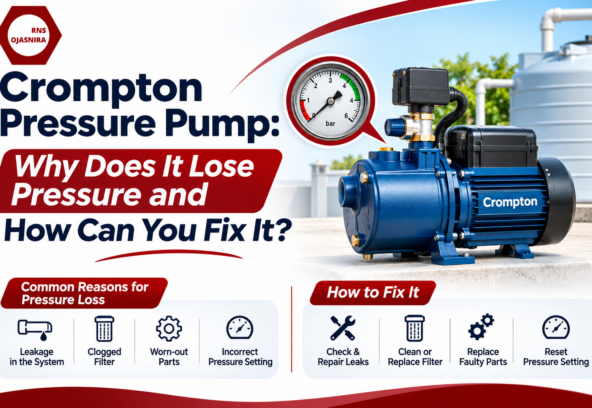

You open the tap and what should be a strong stream is a dribble. The pump is humming away, so it’s clearly running, but the pressure just isn’t there. If you own a Crompton pressure pump, this is one of the most common complaints, and the cause is often simpler than people expect.
Pressure loss almost always traces back to a handful of problems. With a few observations and some basic checks, you can usually narrow it down before calling anyone.
First, notice how the pressure drops
The pattern tells you a lot.
- Gradual loss over weeks: Often a clogged strainer, scale buildup in pipes, or a worn impeller.
- Sudden loss: Look at air in the suction line, a lost prime, a blocked foot valve, or a power issue.
- Weak only when several taps are open: Pipes may be undersized, a valve may be partly closed, or the supply voltage may be low.
- Pump runs but delivers almost nothing: Check the water level at the source and whether the pump has lost its prime.
Air in the suction line
A pump can only push water it manages to draw in. If air sneaks into the suction side through a loose union, a cracked fitting, or a worn gasket, the pump struggles. You’ll often hear gurgling, see water spurting from the taps, or notice pressure that rises and falls.
Tighten the fittings, replace any tired gaskets, and re-prime the pump by filling the casing and suction pipe with water as your manual describes.
A blocked strainer, foot valve, or choked pipe
The foot valve sits at the bottom of the suction pipe and keeps water in the line. If it sticks open, water drains back, and the pump loses its prime. If it clogs, the flow gets restricted. Strainers collect debris for the same reason. Clean both regularly, especially if your source water carries silt. In older plumbing, scale can also narrow the pipes over the years.
A worn or jammed impeller
The impeller is the spinning part that throws water outward. Debris can jam it, and sand in the water slowly wears it down, which reduces pressure and often adds noise. Checking it means opening the pump casing. If you aren’t comfortable doing that, a technician is the safer choice.
Power problems that look like pump problems
Low supply voltage makes the motor run slower, and pressure drops with it. A weak starting capacitor can cause slow starts or humming. Both are jobs for a qualified electrician, so avoid opening electrical parts yourself.
Where the floaty comes in
The floaty is the float switch that controls the pump based on tank water level. When it sticks or is set incorrectly, the pump can keep running with an empty sump. It then pulls in air, loses prime, and pressure collapses. In an overhead tank, a floaty that cuts off too early can mean the tank never fills properly.
Check that it moves freely, that scale hasn’t built up on it, and that the cable isn’t tangled or pressed against the wall. Whether you use a Crompton pump floaty or a Lubi pump floaty, choose one rated for your pump motor’s current and voltage. A mismatch can overheat the contacts over time.
A quick checklist, in order
- Switch off the power before touching anything.
- Check that there’s enough water at the source.
- Inspect the suction fittings for leaks, then re-prime.
- Clean the strainer and foot valve.
- Check that the floaty moves freely and cuts off at the right level.
- Make sure taps and valves are open and no pipe is kinked.
- If pressure is still low, ask a technician to check the impeller, capacitor, and supply voltage.
Mistakes that make things worse
- Running the pump dry “just to see if it picks up”
- Over-tightening plastic fittings until they crack
- Replacing the pump before checking the cheap, simple causes
- Ignoring early changes in the pump’s sound
Putting it together
Pressure loss rarely means the pump itself is finished. Start with air leaks, strainers, and the floaty, then move on to the impeller and power supply. Keep a note of what you changed so you know what worked.
If you need a replacement floaty that suits your pump, RNS Ojasnira can help you choose one that matches your setup.