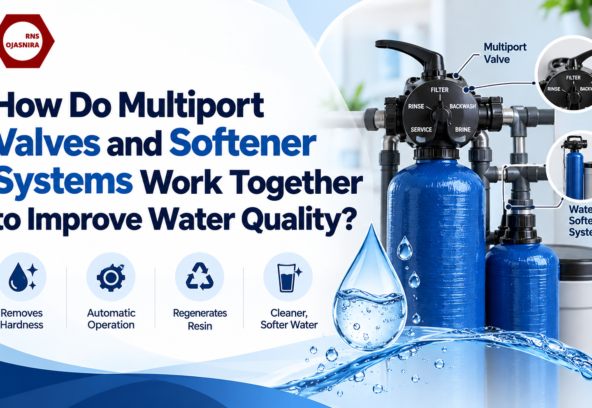

In regions with severely hard water, a water softener is not optional equipment; it has to be part of the planned infrastructure. And the component that controls every stage of that system, from service to backwash to regeneration and rinse, is the multiport valve. When this valve is correctly operated, the softener system runs efficiently, the resin bed stays healthy, and the treated water quality remains consistent. However, incorrect or inconsistent operation leads to hard water passage despite the softening system being part of building or factory infrastructure, resulting in the spoiling of fixtures / equipments downstream of the softener. Understanding how a multiport valve for water softener systems works, and how to operate it for consistent desired results, is practical knowledge that significantly extends system life and prevents the gradual performance decline most users notice only after considerable damage has occurred.
What the Multiport Valve Actually Controls in a Softener System
The multiport valve is a single rotating valve that directs water flow through different paths depending on the position it is in. In a standard ion exchange softener, there are five primary positions that the valve must move through in sequence.
The service position allows raw hard water to enter the top of the resin tank, pass through the resin bed where calcium and magnesium ions are exchanged for sodium ions, and exit as softened water to the distribution system.
The backwash position reverses the flow direction, sending water upward through the resin bed to lift and separate the resin beads, dislodge accumulated sediment and debris, and flush it out to drain. This step is essential in hard water areas where incoming water often carries fine particulate matter that compacts the resin bed and reduces flow rate over time.
The brine draw position pulls the salt solution from the brine tank through the resin bed, driving off the accumulated calcium and magnesium and recharging the resin with sodium. This is the core regeneration step, and its duration and brine concentration directly determine how completely the resin is restored.
The slow rinse position follows brine draw, pushing water slowly through the resin bed to continue displacing the dislodged hardness minerals and begin flushing the remaining brine from the resin.
The fast rinse position runs water through at full service flow rate to finish flushing the resin and restore the bed to its operational condition before the valve returns to service.
In areas with water hardness above 400 parts per million, which is common across many parts of India including Gujarat, Rajasthan, Haryana, and parts of Maharashtra, these cycles need to be executed correctly and consistently. Cutting any one of them short, or advancing past one before it is complete, produces incomplete regeneration and progressively declining softening capacity.
Why Manual Valve Operation Demands Precision
A manual multiport valve puts the entire regeneration sequence in the hands of the user or technician, who physically rotates the valve handle from position to position and times each stage themselves. This gives the operator direct, hands-on control over every stage of the process, but it also means that precision and consistency depend entirely on following the correct sequence and timing every single time.
In hard water problem areas especially, this discipline matters. Skipping a step, cutting a cycle short, or delaying regeneration because the manual sequence was overlooked leads directly to declining softening performance and, over time, unnecessary wear on the resin bed. Because the process is entirely manual, understanding exactly what each position does and being able to recognise where the valve is in its cycle at any given time is essential knowledge for anyone operating or maintaining the system.
RNS Ojasnira manufactures manual multiport valves for both water softener and filtration applications, with valve bodies engineered to resist the mineral scaling that is a particular challenge when the water being handled contains very high calcium and bicarbonate concentrations.
Step-by-Step Manual Operation Procedure: Manual adjustment/operation of a softener multiport valve requires care because the valve must never be forced between positions or stopped partway through a transition. Partial positioning causes internal bypass, allowing untreated water to pass through to the service line or allowing brine to enter the service line, both of which are damaging outcomes.
Before any manual adjustment, close the feed valve to the softener and open the bypass valve to isolate the softener from the service line. This prevents untreated water from entering the soft water storage tank or going to the water distribution lines while the valve is being repositioned. This operation is necessary so that there is a reduction of water pressure inside the multiport valve before its position is rotated and moved to the next position. Rotate the valve handle slowly and steadily in the direction indicated on the valve body, typically clockwise when viewed from the top or from the front depending upon the type of valve you have in your system. Allow the handle to travel fully to the next detent position, which is the notch or click point that confirms the valve has fully seated in that position. Do not stop the rotation partway.
For a manual backwash, move the valve to the backwash position and allow water to flow to drain for the appropriate duration. In hard-water areas with significant particulate loading, a minimum of 10 minutes is typically required to adequately fluidise and clean the resin bed. The water flowing to drain should clear from discoloured to clear before advancing.
After backwash, advance to the brine draw position and allow the brine tank to empty at the rate determined by the brine injector sizing. Do not advance past this position before the brine tank is fully drawn, as incomplete brine draw results in only partial regeneration of the resin.
Advance through slow rinse and then fast rinse before returning the valve to the service position. Once back in service, open the Feed Valve and bypass valve slowly to restore flow to the distribution system.
Adjusting Regeneration Frequency for Severe Hard Water Conditions
Standard regeneration schedules are typically calculated for moderate hardness levels. In areas where water hardness exceeds 500 ppm or where iron content is present alongside hardness, more frequent regeneration is required to prevent the resin from becoming exhausted between cycles.
The practical indicator of an under-regenerated resin bed is hard water breakthrough, where the treated water quality begins to decline before the scheduled regeneration occurs. If this is observed consistently, the regeneration frequency should be increased rather than the salt dose per cycle. Increasing salt dose beyond the resin’s capacity for a single regeneration does not improve the result.
For areas with significant iron in the water alongside hardness, the iron competes with calcium and magnesium for resin exchange sites and is more difficult to remove during standard brine regeneration. In these cases, the slow rinse phase should be extended, and the brine concentration should be maintained at the higher end of the recommended range.
RNS Ojasnira multiport valves for water softener systems used in iron-bearing hard water areas are specified with brine injector sizes calibrated for the extended brine draw volumes these conditions require, rather than applying standard injector sizing that may be inadequate for the actual treatment load.
Signs the Valve Itself Needs Attention, Not Just the Settings
Valve adjustment addresses operational programming. If the valve body has physical problems, adjustment alone will not restore performance.
Internal seal wear is the most common physical issue in multiport valves operating in hard water areas. Hard water scaling on the valve disk and seat reduces the sealing quality at each position, allowing inter-position bypass that contaminates the treated water or allows service flow to pass to drain. Reduced efficiency despite correct settings, treated water that fails a hardness test, or unusual water flow to drain during the service position all indicate seal wear rather than a settings problem.
The valve body’s O-rings should be inspected annually in hard water installations and replaced if any cracking, flattening, or mineral encrustation is visible. The spider gasket or valve disk, which is the internal rotating component that creates the seal at each position, should be inspected every two to three years depending on the hardness of the water being treated.
Conclusion
A multiport valve is the operational heart of any water softener, and in high-hardness water areas it carries significant responsibility. Because the entire regeneration sequence in a manual system depends on correct, consistent handling, a solid working understanding of each valve position and its role is essential knowledge for anyone operating or maintaining one.
Understanding the five valve positions, the correct sequence and timing for each, and the specific adjustments that hard water conditions require gives system owners and maintenance technicians the foundation to keep treated water quality consistent and resin life maximised.
RNS Ojasnira manufactures manual multiport valves for both softener and filtration systems, engineered for scale and the demands of hard water treatment environments across India.